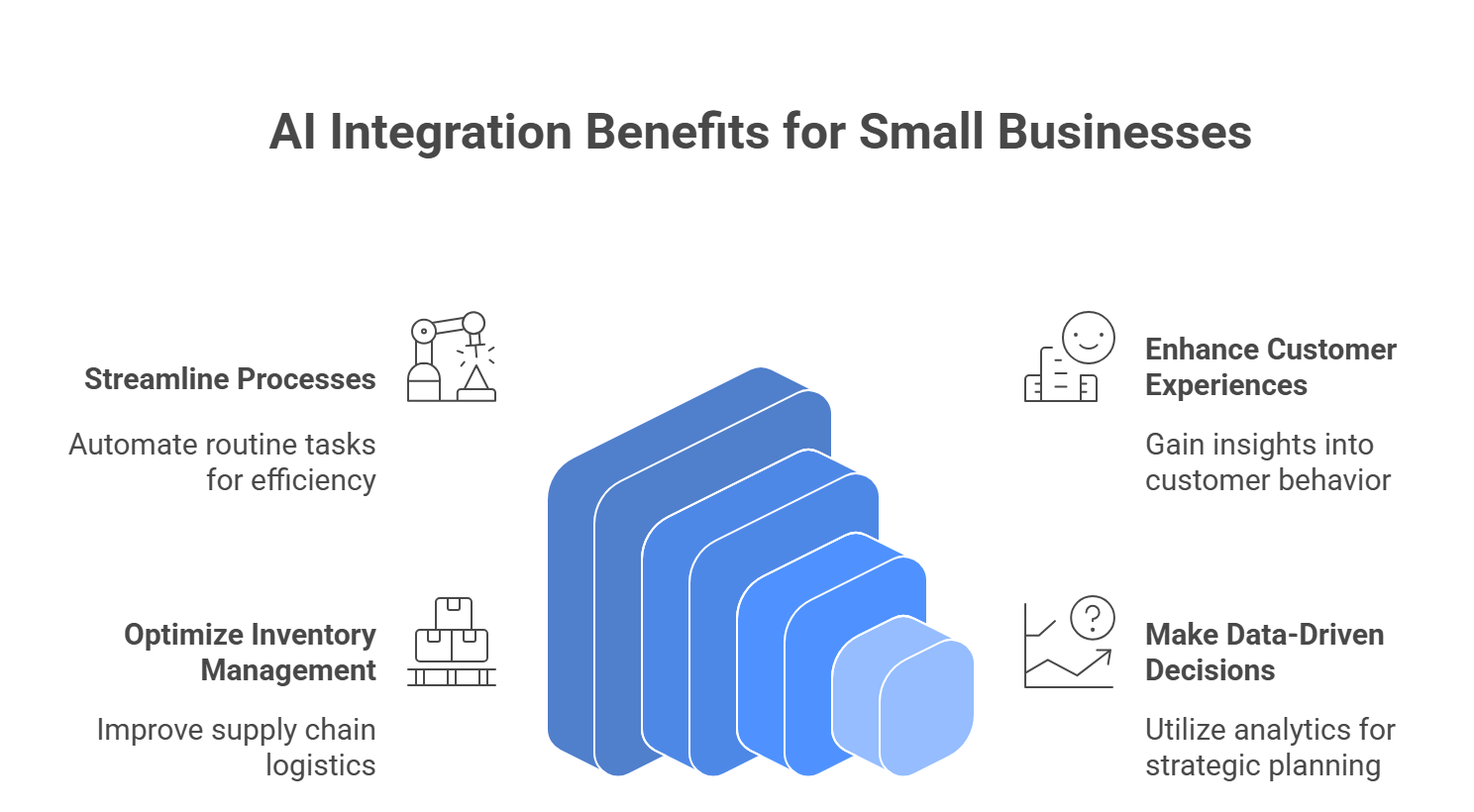
The AI Advantage: A Strategic Blueprint for Small Business Transformation in 2025
The year 2025 marks a definitive turning point in the global economy.
Artificial Intelligence (AI) has transitioned from a speculative novelty to a fundamental operational imperative.
For Small and Medium-sized Businesses (SMBs), the landscape has shifted dramatically.
No longer is advanced technology the exclusive domain of resource-rich conglomerates.
Democratized access to Generative AI (GenAI) has become the great equalizer.
This shift enables agile small enterprises to achieve a state of “superagency.”
In this state, limited human capital is amplified by intelligent systems.
The result is output and efficiency that rivals large corporations.
The stakes are high: top AI adopters expect revenue growth to be 60% higher than their peers by 2027.
This guide provides a comprehensive analysis of the AI landscape for 2025.
We will explore operational restructuring, verified case studies, and practical implementation strategies.
The Era of “Superagency”: A Macroeconomic Shift
Historically, technological revolutions favored incumbents with deep pockets.
However, the AI revolution of 2025 exhibits a unique “U-shaped” adoption curve.
This favors both massive enterprises and nimble micro-businesses.
Data from the U.S. Chamber of Commerce reveals a fascinating trend.
Businesses with fewer than five employees are adopting AI at rates exceeding mid-sized counterparts.
This is driven by necessity: facing labor shortages and wage inflation, micro-businesses use AI as a “synthetic employee.”
This concept is known as “superagency.”
McKinsey & Company describes this as empowering employees to achieve outcomes beyond natural limitations.
An AI agent differs significantly from a simple chatbot.
It has the ability to reason, plan, and execute multi-step workflows across different platforms.
For a small business owner, this means a single marketing manager can function as a full-service agency.
They can generate copy, design visuals, and analyze data simultaneously.
The cost of inaction is rapidly calcifying into a competitive disadvantage.
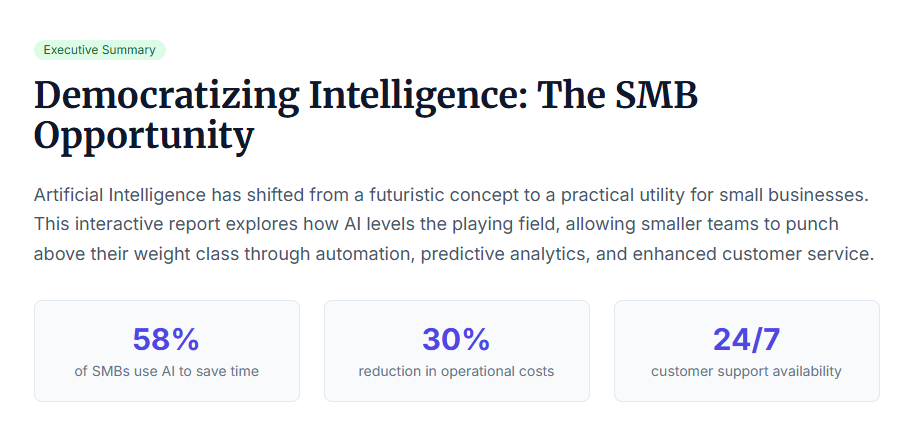
65% of organizations report that AI is critical for staying ahead.
Competitors leveraging AI are reducing operational costs by 30%.
To survive, SMBs must pivot from viewing AI as a tool to viewing it as a workforce partner.
Revolutionizing Customer Experience (CX)
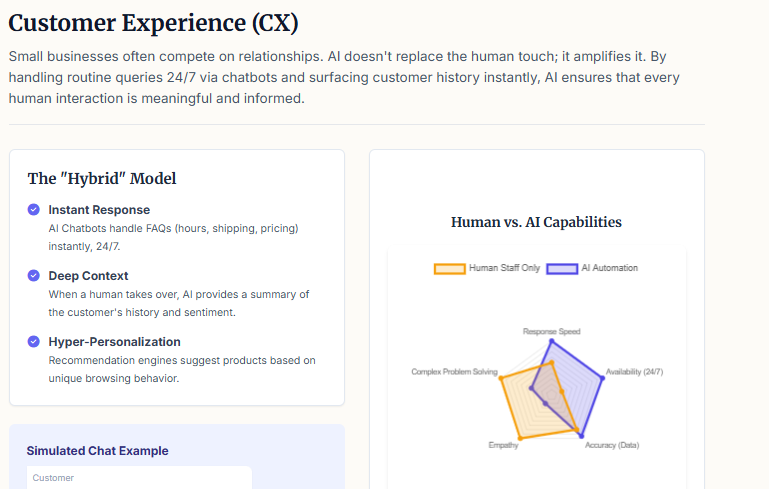
The most immediate application of AI for small businesses lies in Customer Experience (CX).
Consumers in 2025 expect 24/7 availability and instant gratification.
Meeting this standard has historically been impossible for SMBs without expensive outsourcing.
AI chatbots and agents have democratized the “always-on” service model.
These are not the rigid, frustrating bots of the past.
Modern AI utilizes Natural Language Processing (NLP) to understand sentiment and intent.
Case Study: Jones Road Beauty
Jones Road Beauty, a direct-to-consumer cosmetics brand, provides a premier example.
Facing hyper-growth, they encountered a severe bottleneck: 25,000 new support conversations monthly.
This led to a 3-hour response time, causing cart abandonment.
The solution was a sophisticated tech stack centered on Richpanel, an AI-driven support platform.
The Strategy:
Self-Service Architecture: A portal allowed customers to track orders and process returns independently.
Deflection: This system deflected 46% of all incoming tickets.
AI Assist: For human agents, AI suggested responses based on brand tone.
The Results:
Revenue: Support transformed from a cost center to a profit center, generating $1.5 million.
Satisfaction: Trustpilot scores jumped from 2.2 to 4.0 in just 60 days.
Fraud Prevention: AI algorithms identified serial returners, saving $35,000 in fraudulent returns.
This proves that AI in customer service is a revenue driver, not just a cost-cutter.
Marketing Velocity: Content and Attribution
Marketing has traditionally been a resource-heavy function.
It usually requires copywriters, designers, and data analysts.
In 2025, AI tools allow small teams to operate with the capacity of a mid-sized agency.
Generative AI has commoditized the production of baseline content.
Tools like Jasper and ChatGPT allow for the creation of blog posts and ad copy in minutes.
However, the challenge is no longer creation, but differentiation.
Successful SMBs are using platforms that allow for “Brand Voice” customization.
Case Study: Ridge Wallet
Ridge Wallet offers a masterclass in using AI to scale creative output.
The company scaled to $5 million in revenue per employee.
Their secret lies in “Creative Velocity.”
Successful paid advertising relies on testing hundreds of ad variations.
Ridge uses AI to generate ad hooks, visual variations, and copy angles at scale.
They launch up to 500 variations and let the market decide the winner.
Data Science Democratization:
Ridge treats creative strategy as a data problem.
Team members use AI to analyze which visual elements correlate with clicks.
They use Northbeam, an AI attribution tool, to triangulate the true source of sales.
This approach improved their Return on Ad Spend (ROAS) by 24%.
It demonstrates how AI can help small businesses navigate complex privacy updates and ad platforms.
Intelligent Sales Orchestration
For B2B small businesses, the sales cycle is often plagued by manual data entry.
AI automation orchestrates processes to ensure “speed to lead.”
Predictive lead scoring uses machine learning to analyze thousands of data points.
It predicts the likelihood of conversion, increasing win rates by 76%.
Implementation: The Zapier + ChatGPT Workflow
A sophisticated lead orchestration system can be built without a dedicated engineering team.
Using “no-code” tools like Zapier, here is a practical workflow:
1. The Trigger
A potential client submits a form on your website.
2. AI Analysis (The Brain)
Zapier sends raw data to ChatGPT with a system prompt.
The prompt asks AI to classify the lead: “High Priority,” “Nurture,” or “Unqualified.”
3. The Router (The Logic)
Zapier splits the workflow based on classification.
High Priority: Creates a deal in the CRM and notifies the Sales Director.
Nurture: Adds the contact to an educational email drip campaign.
Unqualified: Sends a polite, automated rejection email.
4. Enrichment
For high-priority leads, the system searches for the decision-maker’s LinkedIn profile.
This ensures human sales reps only focus on leads ready to buy.
Operational Efficiency and Inventory Management
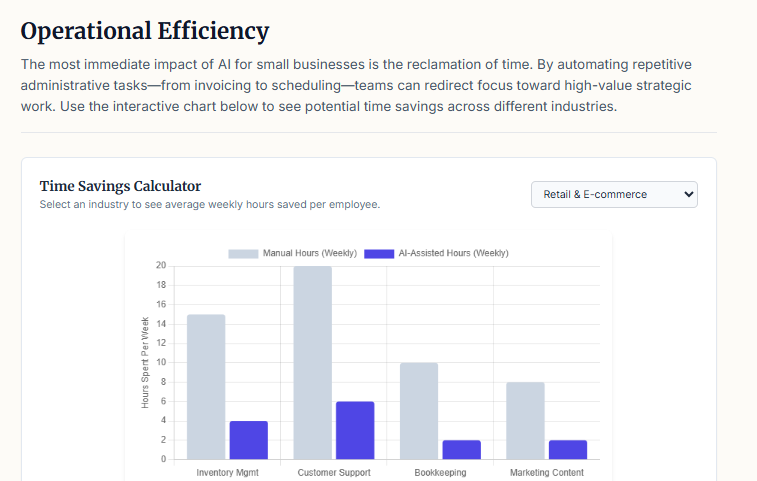
For retailers and food service businesses, inventory is a high-stakes balancing act.
Too much inventory ties up capital; too little leads to lost sales.
AI demand forecasting analyzes historical sales, weather, and local events to predict the future.
This technology typically reduces inventory levels by 15-30% while improving availability.
Case Study: Hometown Hearth Bakery
Hometown Hearth Bakery illustrates the impact on “Main Street” operations.
They faced unpredictable demand, leading to either early sell-outs or massive waste.
The Transformation:
Data Ingestion: The system analyzed three months of sales receipts.
Predictive Modeling: AI predicted daily demand based on weather and history.
Smart Production: A daily “bake sheet” told the kitchen exactly what to produce.
The Result:
In six months, the bakery doubled its monthly revenue.
They significantly reduced food waste and eliminated 3 AM wake-up calls.
This validates that AI is vital for brick-and-mortar businesses, not just digital startups.
The 2025 AI Tool Stack: A Buyer’s Guide
Selecting the right technology stack is critical to avoid subscription bloat.
Small businesses must prioritize versatile, high-impact tools.
Below is a strategic breakdown of the essential AI toolkit for 2025.
| Category | Recommended Tool | SMB Pricing (Est.) | Primary Use Case |
| Automation | Zapier | Free – $29.99/mo | Connects apps (e.g., Forms to CRM). The “Orchestrator” of workflows. |
| Generative AI | ChatGPT (Team) | $25 – $30/user/mo | Versatile agent for coding, drafting, and strategy. Ensures data privacy. |
| Meeting AI | Fireflies.ai | $10 – $18/user/mo | Records and transcribes meetings. Provides summaries and action items. |
| HR/Payroll | TalentHR | ~$2/user/mo | Low-cost entry for employee management and recruitment. |
| Global HR | Deel | $599/mo (EOR) | Essential for hiring international talent compliantly. Mitigates legal risk. |
| Support | Richpanel | Ticket Based | High automation rates for e-commerce. Reduces support labor costs. |
| CRM | HubSpot Starter | ~$15/user/mo | Centralized data with built-in AI for email drafting and automation. |
Note: Pricing is based on 2025 market data and subject to change.
Governance and Risk Management
The integration of AI introduces significant risks that must be managed.
“Shadow AI”—employees using unapproved tools—is a growing threat.
Legal Liability: The Air Canada Warning
A landmark ruling involving Air Canada serves as a critical warning.
A tribunal ruled the airline was liable for its chatbot’s advice regarding refunds.
The Lesson: You are legally responsible for every word your AI agents generate.
Mitigation Checklist:
Program strict guardrails into chatbots.
Direct complex billing or legal queries to human agents immediately.
Implement a “Human-in-the-Loop” review for sensitive outputs.
Developing an Acceptable Use Policy (AUP)
Every small business needs an AI Acceptable Use Policy.
This document protects the business and guides employees.
Key Components of an AUP:
Approved Tools: A whitelist of vetted applications (e.g., “ChatGPT Team is allowed”).
Data Classification: Instructions on what data can be entered into AI.
Red Light Data: Client financial data, passwords, and proprietary code must never be input into public models.
Disclosure: Rules on when to disclose AI use to customers.
Implementation Roadmap: Crawl, Walk, Run
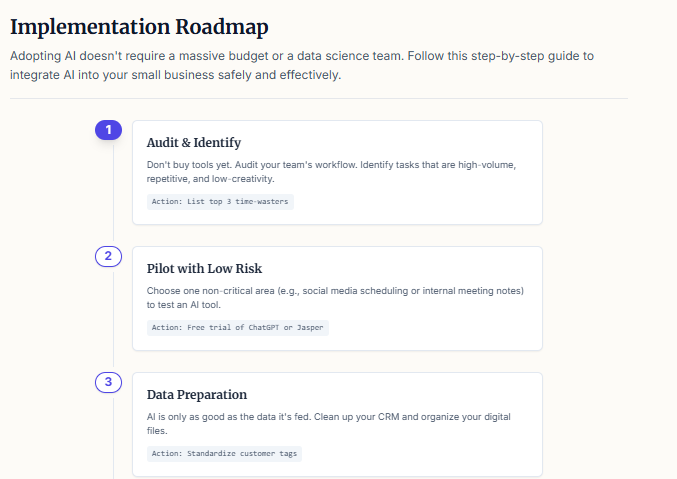
Implementing AI can be overwhelming without a structured approach.
Use this phased framework to avoid “pilot purgatory.”
Phase 1: Crawl (Months 1-3)
Goal: Individual productivity and tool familiarity.
Provide ChatGPT Team licenses to key employees.
Establish the Acceptable Use Policy (AUP).
Implement Fireflies.ai to transcribe meetings (low friction, high value).
Use AI to assist with routine social media posts.
Phase 2: Walk (Months 3-6)
Goal: Solving functional pain points with automation.
Deploy a basic chatbot for FAQs and order tracking.
Set up the Zapier + ChatGPT lead classification workflow.
Implement TalentHR to streamline employee records.
Metric: Measure time saved per week per department.
Phase 3: Run (Month 6+)
Goal: Strategic transformation and “Superagency.”
Adopt Predictive Inventory Modeling to optimize cash flow.
Build Custom Agents trained on company SOPs for onboarding.
Analyze raw data exports with AI to find efficiency gaps.
Conclusion
By 2025, the question is no longer if small businesses should adopt AI.
The question is how deeply they can integrate it to thrive.
From a local bakery reducing waste to a cosmetics brand generating millions, the evidence is clear.
AI is the engine of modern small business growth.
The convergence of accessible pricing and agentic capabilities lowers the barrier to entry.
However, success requires a strategic pivot.
Business owners must view AI as a force multiplier.
It is a synthetic workforce that allows a small firm to operate with the power of a giant.
As the adoption gap closes, businesses that master “superagency” will outmaneuver their rivals.
Start your transformation today; the tools are ready, and the market is waiting.