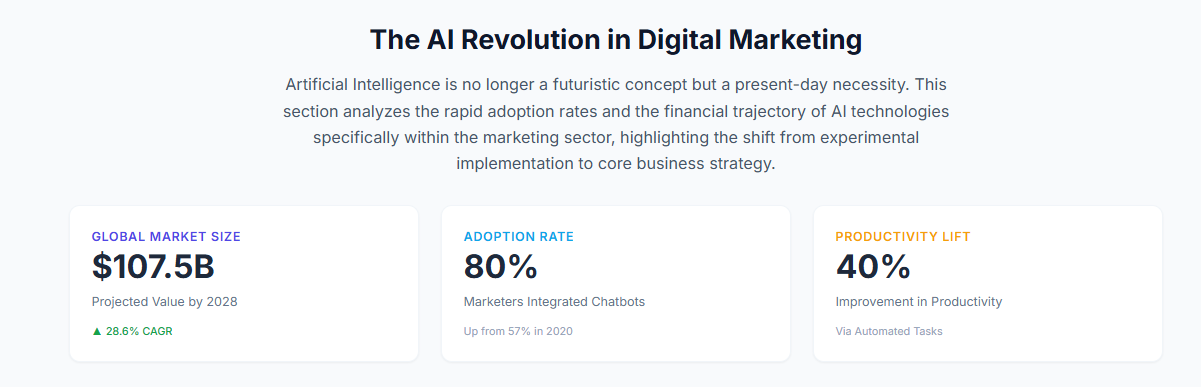
The digital marketing landscape has fundamentally shifted. We are no longer in the phase of playful experimentation with chatbots.
In 2025, Artificial Intelligence has matured into an industrial-grade infrastructure. It now powers everything from predictive audience modeling to autonomous content generation.
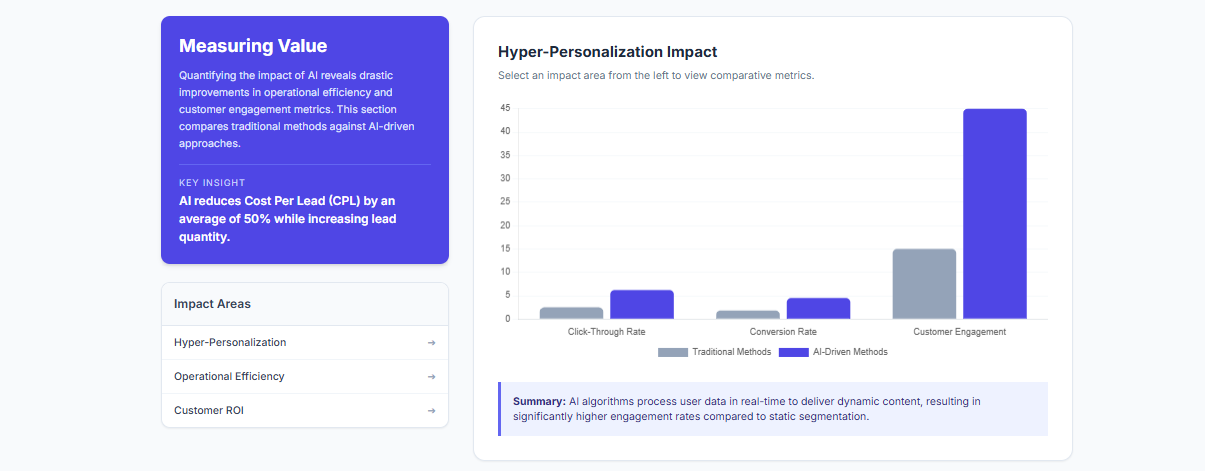
However, a divide has emerged. Some brands are slashing costs by 37% using “Agentic AI,” while others face consumer backlash for “soulless” synthetic content.
This article provides a strategic roadmap for navigating this transformation. We will explore the rise of autonomous agents, the transition from SEO to AEO, and the critical need for human authenticity.
Here is what you will learn in this guide:
-
The difference between Generative AI and the new Agentic AI.
-
How companies like Klarna are redefining operational efficiency.
-
Strategies to avoid the “Uncanny Valley” of AI creativity.
-
The essential pivot from Search Engine Optimization to Answer Engine Optimization.
The Rise of Agentic AI: From “Co-Pilot” to “Auto-Pilot”
The most significant technological leap in 2025 is the transition from Generative AI (GenAI) to Agentic AI.
In previous years, marketers used GenAI to draft emails or create images. This required a human prompt for every single output.
Agentic AI is different. These systems are goal-directed and autonomous.
They perceive their environment, reason through complex problems, and execute multi-step workflows without constant human intervention.
For example, instead of asking a bot to “write an email,” you assign an agent a goal: “Maximize conversions for the summer sale.”
The agent then analyzes data, selects the channel, crafts the message, sends it, and iterates based on results—all on its own.
The Core Difference: Automation vs. Agentic AI
Understanding this distinction is vital for modernizing your marketing stack.
| Feature | Traditional Automation | Agentic AI |
| Core Function | Executes pre-defined rules | Achieves autonomous goals |
| Adaptability | Rigid; breaks if parameters change | Adaptive; learns from the environment |
| Trigger | Reactive (Event-based) | Proactive (Goal-based) |
| Decision Making | None (Deterministic) | Probabilistic reasoning & planning |
Key Takeaway: Move your strategy from simple task automation to goal-oriented agent deployment to scale personalization effectively.
The “Klarna Effect”: A Blueprint for Extreme Efficiency
The potential for AI to restructure corporate operations is best illustrated by the fintech giant, Klarna.
In 2024 and 2025, Klarna became the industry bellwether for AI-driven efficiency, coining the term “The Klarna Effect.”
The company successfully reduced sales and marketing spending by 11% while simultaneously increasing campaign frequency.
They attributed 37% of these savings directly to AI initiatives, reclaiming approximately $10 million annually.
How Klarna Achieved These Results
Klarna’s strategy offers a practical checklist for organizations looking to streamline operations:
-
Disintermediation: They reduced spending on external agencies by 25%, bringing translation, CRM, and social production in-house.
-
Internalizing Production: Using tools like Midjourney and Adobe Firefly, they slashed image production costs by $6 million.
-
Workflow Compression: The image development cycle was reduced from six weeks to just seven days.
-
AI Copywriting: A proprietary “Copy Assistant” now generates 80% of all marketing copy, ensuring brand consistency.
This shift has created a demand for “marketing engineers”—hybrid professionals who bridge the gap between creative strategy and algorithmic management.
Navigating the Creative Frontier: Authenticity vs. The Uncanny Valley
While efficiency is a clear win, creativity remains a minefield.
The industry is currently grappling with the “Uncanny Valley.” This is the unease consumers feel when viewing synthetic simulations that look almost, but not quite, human.
The Trap of Synthetic Emotion
Coca-Cola’s 2024 holiday campaign serves as a cautionary tale.
The brand attempted to remake its beloved “Holidays Are Coming” commercial using entirely GenAI video tools.
The result was widely criticized as “soulless” and “dystopian.” Viewers noticed unnatural movements and lifeless faces, leading to a pivot in 2025.
The Path to Success: Playfulness and Transparency
Conversely, brands that use AI as a tool for play rather than deception are thriving.
Successful AI Campaign Checklist:
-
Be Transparent: Acknowledge the use of AI. Virgin Voyages’ “Jen AI” campaign worked because it jokingly admitted Jennifer Lopez couldn’t call everyone personally.
-
Invite Collaboration: Heinz asked users to prompt AI to “draw ketchup,” turning the technology into a community game.
-
Enhance, Don’t Replace: Use AI to do what humans physically cannot, such as Nutella generating 7 million unique label designs.
From SEO to AEO: The Answer Engine Revolution
The way consumers find information has changed fundamentally.
The traditional “10 blue links” on Google are being replaced by direct answers from AI, known as Answer Engine Optimization (AEO).
Platforms like ChatGPT Search, Perplexity, and Google AI Overviews now synthesize answers using Retrieval-Augmented Generation (RAG).
If your content is not structured for machine perception, you become invisible.
Optimizing for Machine Perception
To succeed in an AEO world, marketers must shift their focus from keywords to “concept ownership.”
-
Structure Data: Use schema markup to help AI understand entity relationships.
-
Direct Answers: Format content to provide concise, direct answers to specific user questions.
-
Track Perception: Use tools like Profound and Rank Prompt to monitor how often your brand is cited as a source of truth by LLMs.
-
Deep Authority: AI handles simple queries (like weather or definitions). Your site must provide the deep, authoritative content that AI cannot generate on its own.
Hyper-Personalization and Physical Operations
Leading brands are taking AI beyond digital screens and into the physical world.
Starbucks uses “Deep Brew,” an AI engine that functions as the company’s operational nervous system.
It integrates data from inventory, local weather, and store traffic to optimize drive-thru menus in real-time.
If a store is low on cold brew, the digital menu automatically updates to promote other items, managing inventory and demand simultaneously.
Nike’s Demand Sensing
Similarly, Nike utilizes “demand sensing” algorithms.
They analyze local data to predict regional trends, stocking stores with products the local community is likely to want.
This shifts the supply chain from a “push” model (selling what is made) to a “pull” model (making what will sell).
Governance and Ethics: The Regulatory Perimeter
As AI capabilities expand, regulatory scrutiny is tightening.
The EU AI Act has set the global standard, and compliance is no longer optional.
Key Compliance Priorities for 2025
-
Transparency: You must inform users when they are interacting with an AI system (e.g., a chatbot).
-
Labeling: Deepfake or artificially manipulated content must be clearly labeled.
-
Bias Mitigation: Regular audits are required to ensure algorithms do not discriminate in ad targeting or hiring.
-
Truth-in-Advertising: The FTC has clarified that brands are liable for “hallucinations” or false claims made by their AI agents.
Conclusion
The integration of AI into digital marketing is the industrial revolution of our sector.
It offers unprecedented opportunities for velocity and personalization. However, it demands a reimagining of the marketing organization.
Success requires a dual strategy: aggressive adoption of Agentic AI for efficiency, and a radical commitment to human authenticity for connection.
Next Step: Conduct an audit of your current marketing stack. Identify one repetitive workflow that can be upgraded to an “Agentic” workflow, and one piece of creative content where you can inject more raw human storytelling to balance the tech.